Our research group is actively conducting research on inherited eye diseases. You are also welcome to contact us with a low threshold regarding inherited eye conditions, even if the specific disease is not listed.
How to Participate
We welcome samples from all dogs affected by eye diseases as well as from their close relatives. Samples are especially needed for ongoing studies. We hope that copies of official eye examination certificates and other veterinary reports are included with the sample. In addition, we welcome samples from dogs of all breeds that have been examined and found healthy at over 6 years of age.
See our ongoing research projects here!
Contact Persons
Sara Mikkonen, doctoral researcher: sara.mikkonen@helsinki.fi
Janika Juusola, doctoral researcher: janika.juusola@helsinki.fi
Retinal degeneration
Retinal degenerations are classified based on which retinal cells are affected. Retinal degeneration often first appears as night blindness and, as it progresses, leads to complete blindness. The most common retinal degeneration in dogs is PRA, for which the genetic background has been identified in several breeds.
Corneal diseases
Diseases of the cornea include, for example, corneal dystrophy and pannus.
Corneal dystrophy is a disease of the transparent, light-refracting front layer of the eye. There are several forms of corneal dystrophy, the most common of which causes lipid or calcium deposits in the front parts of the cornea. Pannus, or chronic superficial keratitis, is an progressive autoimmune eye disease. Pannus can lead to blindness in dogs, especially if left untreated.
Developmental abnormalities of the eye
Developmental abnormalities of the eye include, for example, various colobomas, microphthalmia, and retinal dysplasia.
Coloboma refers to a developmental defect of the eye in which part of the eye tissue is missing. A coloboma can form, for example, in the retina or the iris (also iris hypoplasia), and its effect on a dog’s vision depends on the location and size of the coloboma. Microphthalmia, in turn, refers to congenital underdevelopment of the eye. The eyes may be smaller than normal, and eye examinations may reveal changes in one or more parts of the eye.
Retinal dysplasia (RD) is a congenital developmental disorder of the retina in which folds and local detachments form in the retina. In more severe cases, the entire retina detaches. Retinal dysplasias are divided into three classes based on the severity of the retinal detachment.
Glaucoma
Glaukoomassa In glaucoma, the cells of the retina and the optic nerve head degenerate. In dogs, glaucoma is often associated with increased intraocular pressure, which causes pain. Glaucomas are divided into several subtypes based on their underlying mechanism. Glaucoma can lead to blindness. especially if left untreated.
Other eye diseases
Pectinate ligament dysplasia (PLD) is a developmental defect of the eye’s anterior chamber angle that predisposes to glaucoma.
In vitreous degeneration, the gel-like vitreous becomes more watery, and vitreous fluid may leak into the anterior chamber. Additionally, flake-like opacities can be observed in the vitreous.
Lens luxation can be primary or secondary, meaning it is caused by another predisposing factor. Primary lens luxation results in the breaking of the lens’s suspensory fibers and the displacement of the lens. Secondary lens luxation can be caused, for example, by glaucoma.
Nystagmus in dogs appears as involuntary back-and-forth eye movements. The cause of nystagmus can vary.
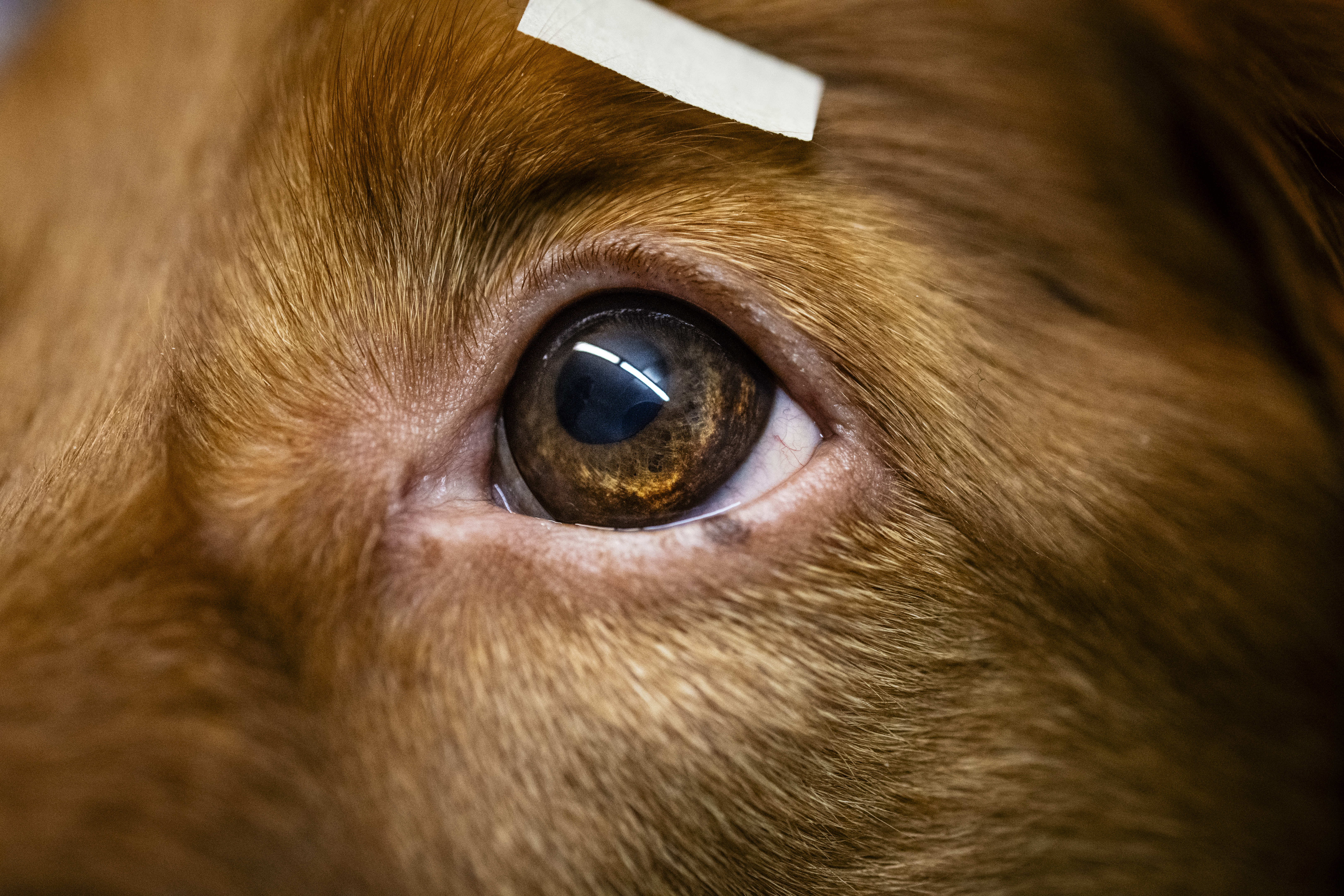
Photo: Veikko Somerpuro
Results
Multiocular defect in the Old English Sheepdog: A canine form of Stickler syndrome type II associated with a missense variant in the collagen-type gene COL11A1. Stanbury K, Stavinohova R, Pettitt L, Dixon C, Schofield EC, Mclaughlin B, Pettinen I, Lohi H, Ricketts SL, Oliver JA, Mellersh CS. PLoS One. 2023 Dec 28;18(12):e0295851.
A Missense Variant in the Bardet-Biedl Syndrome 2 Gene (BBS2) Leads to a Novel Syndromic Retinal Degeneration in the Shetland Sheepdog. Hitti-Malin RJ, Burmeister LM, Lingaas F, Kaukonen M, Pettinen I, Lohi H, Sargan D, Mellersh CS. Genes (Basel). 2021 Nov 8;12(11):1771.
A missense variant in IFT122 associated with a canine model of retinitis pigmentosa. Kaukonen M, Pettinen IT, Wickström K, Arumilli M, Donner J, Juhola IJ, Holopainen S, Turunen JA, Yoshihara M, Kere J, Lohi H. Hum Genet. 2021 Feb 19. ”Koiratutkimus paljasti uuden sokeuteen vaikuttavan geenin”
A putative silencer variant in a spontaneous canine model of retinitis pigmentosa. Kaukonen M, Quintero IB, Mukarram AK, Hytönen MK, Holopainen S, Wickström K, Kyöstilä K, Arumilli M, Jalomäki S, Daub CO, Kere J, Lohi H; DoGA Consortium. PLoS Genet. 2020 Mar 9;16(3):e1008659. ”Verkkokalvon häiriintynyt geenitoiminta koirien sokeuden taustalla”
Maternal Inheritance of a Recessive RBP4 Defect in Canine Congenital Eye Disease. Kaukonen M, Woods S, Ahonen S, Lemberg S, Hellman M, Hytönen MK, Permi P, Glaser T, Lohi H. Cell Rep. 2018 May 29;23(9):2643-2652. ”Syypäänä äidin geenit: koirien silmäsairaustutkimus paljasti uudenlaisen periytymistavan”
A Coding Variant in the Gene Bardet-Biedl Syndrome 4 (BBS4) Is Associated with a Novel Form of Canine Progressive Retinal Atrophy. Chew T, Haase B, Bathgate R, Willet CE, Kaukonen MK, Mascord LJ, Lohi HT, Wade CM. G3 (Bethesda). 2017 Jul 5;7(7):2327-2335. doi: 10.1534/g3.117.043109.